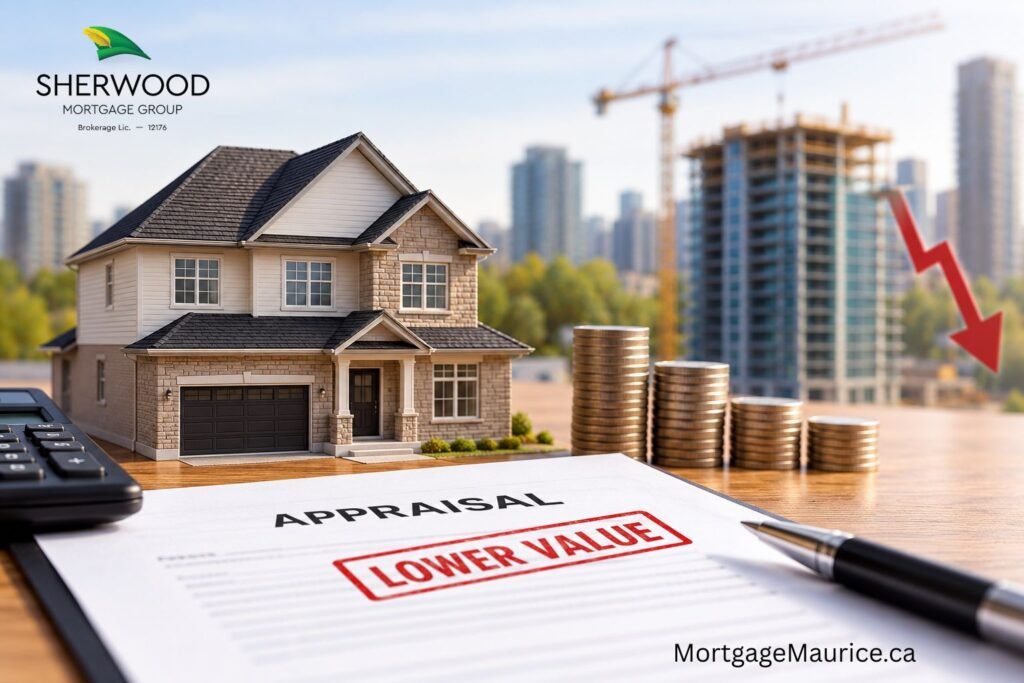
Buying a home is one of the largest financial commitments most Canadians will ever make. But what happens when the property you agreed to purchase is worth substantially less than the lender’s appraisal?
Imagine purchasing a pre-construction property in Ontario several years ago, paying substantial deposits, and waiting patiently for completion.
As closing approaches, the lender’s appraisal comes back 20% or even 30% below your original purchase price.
Suddenly, the mortgage financing you expected may no longer be available. You could need hundreds of thousands of dollars in additional cash to complete the transaction.
Worse still, if you cannot close, you could lose your deposit and face additional legal liability.
This is the serious financial risk of an appraisal gap.
What Is an Appraisal Gap?
An appraisal gap occurs when a property’s lender-accepted value is lower than its agreed purchase price.
For conventional mortgage financing, lenders generally calculate the maximum mortgage using the lower of the purchase price and the accepted appraised value.
For example, if you purchase a property for $1 million but the lender appraises it at $800,000, the appraisal gap is $200,000, or 20%.
However, the lower appraisal does not automatically reduce your contractual purchase price. You may still be obligated to pay the full $1 million.
Let’s examine two practical examples.
Example 1: A $1.2 Million Owner-Occupied Home
Suppose a couple purchases a pre-construction home for $1.2 million.
They have already paid $180,000 in progressive deposits, representing 15% of the purchase price.
They originally plan to arrange a conventional mortgage at 80% loan-to-value (LTV).
Unfortunately, the lender’s final appraisal comes back at only $960,000 — 20% below the purchase price.
Here is how their financing changes:
| Financing Details | Original Plan | After Appraisal |
|---|---|---|
| Purchase price | $1,200,000 | $1,200,000 |
| Appraised value | $1,200,000 | $960,000 |
| Maximum mortgage (80% LTV) | $960,000 | $768,000 |
| Deposits already paid | $180,000 | $180,000 |
| Remaining cash required | $60,000 | $252,000 |
Instead of contributing another $60,000 at closing, the couple must now find $252,000.
That represents an unexpected additional cash requirement of $192,000.
These figures exclude land transfer tax, legal fees, and other closing expenses.
Could Mortgage Insurance Help?
Possibly.
Since December 15, 2024, eligible owner-occupied homes with purchase prices below $1.5 million may qualify for high-ratio mortgage default insurance.
This applies to eligible first-time and repeat homebuyers.
Insured financing may permit a higher LTV than conventional financing, potentially reducing the additional cash requirement.
However, approval remains subject to the lender’s accepted appraisal, borrower qualifications, mortgage insurer requirements, and lender approval.
For simplicity, our example assumes conventional financing at 80% LTV.
Example 2: A $730,000 Pre-Construction Rental Condominium
Now consider an investor who purchases a pre-construction condominium for $730,000, intending to rent it out.
The purchaser has already paid $109,500 in progressive deposits, representing 15% of the purchase price.
Originally, the investor expects to arrange a conventional mortgage at 80% LTV.
Unfortunately, when the condominium is completed, the lender’s appraisal comes back at just $511,000 — a 30% decline from the purchase price.
| Financing Details | Original Plan | After Appraisal |
|---|---|---|
| Purchase price | $730,000 | $730,000 |
| Appraised value | $730,000 | $511,000 |
| Appraisal gap | — | 30% |
| Maximum mortgage (80% LTV) | $584,000 | $408,800 |
| Deposits already paid | $109,500 | $109,500 |
| Remaining cash required | $36,500 | $211,700 |
The investor originally expected to contribute another $36,500 at closing.
Following the lower appraisal, the remaining cash requirement increases to $211,700.
That represents an unexpected additional cash requirement of $175,200.
These calculations exclude closing costs and assume the lender approves financing at the full 80% LTV.
For a single-unit rental condominium that is not owner-occupied, standard high-ratio mortgage default insurance is generally unavailable.
Conventional financing is therefore typically required, with a maximum LTV of 80%, subject to lender approval.
The actual mortgage amount may be lower depending on the investor’s income, existing debts, rental income, and other underwriting requirements.
What If the Investor Cannot Refinance Their Existing Home?
Some investors assume they can refinance their principal residence to raise additional funds when needed.
However, this strategy may not work if their existing home has also declined in value or is already heavily mortgaged.
With insufficient available equity, refinancing their home may not provide the additional funds required to close the investment purchase.
This illustrates how a pre-construction investment can potentially affect the purchaser’s overall financial security.
Why Are Appraisal Gaps Particularly Concerning in Ontario?
Ontario’s housing market has experienced significant adjustments since the exceptionally strong conditions earlier in the decade.
Pre-construction buyers can be particularly vulnerable because purchase agreements may have been signed several years before the properties are completed.
During that period, market conditions, comparable sale prices, interest rates, and lending requirements may change considerably.
A price agreed upon years ago does not guarantee that a lender will accept the same property valuation today.
Our examples of 20% and 30% appraisal gaps are illustrative and do not suggest that all Ontario properties have experienced declines of this magnitude.
Could You Lose Your Deposit If You Cannot Close?
Yes.
Once an Ontario Agreement of Purchase and Sale becomes firm and binding, the purchaser generally remains obligated to complete the transaction.
A low appraisal or inability to obtain mortgage financing does not automatically release the buyer from that obligation.
If the purchaser defaults, the seller or developer may be entitled to retain the deposit and pursue additional damages.
These damages could include losses arising from a subsequent resale at a lower price, together with certain reasonable additional expenses.
In Azzarello v. Shawqi, 2019 ONCA 820, the Ontario Court of Appeal confirmed that a forfeited deposit must be credited against damages awarded to a seller who has suffered a compensable loss.
The deposit is therefore not simply added again to the damages.
Nevertheless, a purchaser’s total financial liability can exceed the original deposit.
The outcome depends on the purchase agreement, the circumstances, and applicable law.
Five Ways Buyers Can Reduce Appraisal-Gap Risks
1. Arrange Financing Before Making an Offer
Consult an experienced mortgage broker to understand your borrowing capacity, down payment requirements, and available financing options.
2. Prepare for a Lower Appraisal
Before committing, calculate the additional funds required if the property is appraised 10%, 20%, or even 30% below the purchase price.
3. Maintain Adequate Financial Reserves
Avoid assuming your original down payment will be sufficient at closing, particularly for pre-construction purchases with extended completion periods.
4. Review Your Mortgage Approval Before Closing
A mortgage pre-approval is not a guarantee of final financing.
Lenders may reassess income, credit, debts, property valuation, and outstanding conditions before advancing funds.
5. Understand Your Legal Obligations
Before signing or waiving financing conditions, discuss the risks with your real estate lawyer.
Understand the consequences if financing becomes unavailable and the transaction cannot be completed.
What Can You Do If the Appraisal Comes in Low?
A disappointing appraisal does not automatically mean the transaction must collapse.
Depending on the circumstances, possible solutions include:
- Requesting an appraisal review supported by recent comparable sales.
- Exploring mortgage financing with another lender.
- Increasing the down payment using acceptable sources of funds.
- Negotiating a purchase price reduction with the seller.
- Requesting a closing extension.
- Considering secondary or private mortgage financing.
However, alternative financing may involve higher interest rates, additional fees, shorter terms, and increased financial risks.
Every option requires careful assessment, including a realistic repayment strategy. No financing solution is guaranteed.
If closing is in jeopardy, seek legal advice promptly.
Final Thoughts: Protect Your Deposit Before You Commit
An appraisal gap can turn an otherwise manageable property purchase into a serious financial challenge.
Our two examples demonstrate that:
- A 20% appraisal decline on a $1.2 million owner-occupied home could require an unexpected additional $192,000.
- A 30% appraisal decline on a $730,000 rental condominium could require an unexpected additional $175,200.
These substantial amounts can be difficult to raise, particularly when buyers have already committed significant deposits.
Before purchasing a property, ask yourself:
Could I still complete this purchase if the lender’s appraisal came in 20% or even 30% below the agreed purchase price?
Understanding these risks before signing could help protect your savings and financial future.
As an experienced Ontario mortgage broker with more than 30 years in the industry, I would be pleased to help you evaluate your financing options and prepare for a successful closing.
Maurice Kwok, MBA, CPA, FSRA Lic.# M13000496
Mortgage Broker | Sherwood Mortgage Group, FSRA Lic.#12176
Further Reading and References
This article was inspired by Deeded’s discussion of appraisal-gap risks in Ontario.
Additional references:
- Government of Canada – Mortgage Insurance Reforms
- CMHC – Income Property Mortgage Insurance
- Azzarello v. Shawqi, 2019 ONCA 820 – Ontario Court of Appeal
Disclaimer
This article is provided for general educational purposes only and does not constitute legal, financial, or mortgage approval advice. Mortgage financing is subject to lender approval and applicable underwriting requirements. Purchasers should obtain independent legal advice concerning their contractual obligations and potential liabilities.

Maurice Kwok ・ 郭澤文
Mortgage Broker, CPA, MBA ・ 粵語 ・ 國語
FSRA-licensed Mortgage Broker (Licence #M13000496)
Sherwood Mortgage Group (FSRA Brokerage Lic.#12176)
Your trusted mortgage guide since 1995.